
The formulation and implementation of strategy, including your AI strategy, is the key to addressing the threats and opportunities that change presents.
We offer thought leadership in helping you address the big picture issues that impact your ability to carry out your vision for the future, as well as improve the productivity of your human capital. Today that includes AI. We help organizations, government agencies, and consultancies take on AI with confidence, with a focus on the part technology vendors skip: change management, governance, and executive decision-making.
We provide the full scope of consulting services that fortify the ability to truly embrace change. In many cases our expertise is integrated into the development of thought leaders at all levels of the organization. The full complement of our skills includes:
- Conducting Organizational Assessments/Diagnosis
- Assessing AI Readiness and Selecting Processes to Automate
- Analyzing Optimal Organization Structure
- Developing AI Transformation Strategy and Roadmaps
- Implementing Workforce and Succession Planning
- Leading AI Change Management and Adoption
- Structuring Leadership Development Programs
- Building AI Literacy for Leaders and Teams
- Establishing AI Governance Frameworks and Policies
Read Before You Invest in AI
AI promises a lot, but the real work begins after the purchase. These two articles are free to read, and they could save you from some expensive surprises.
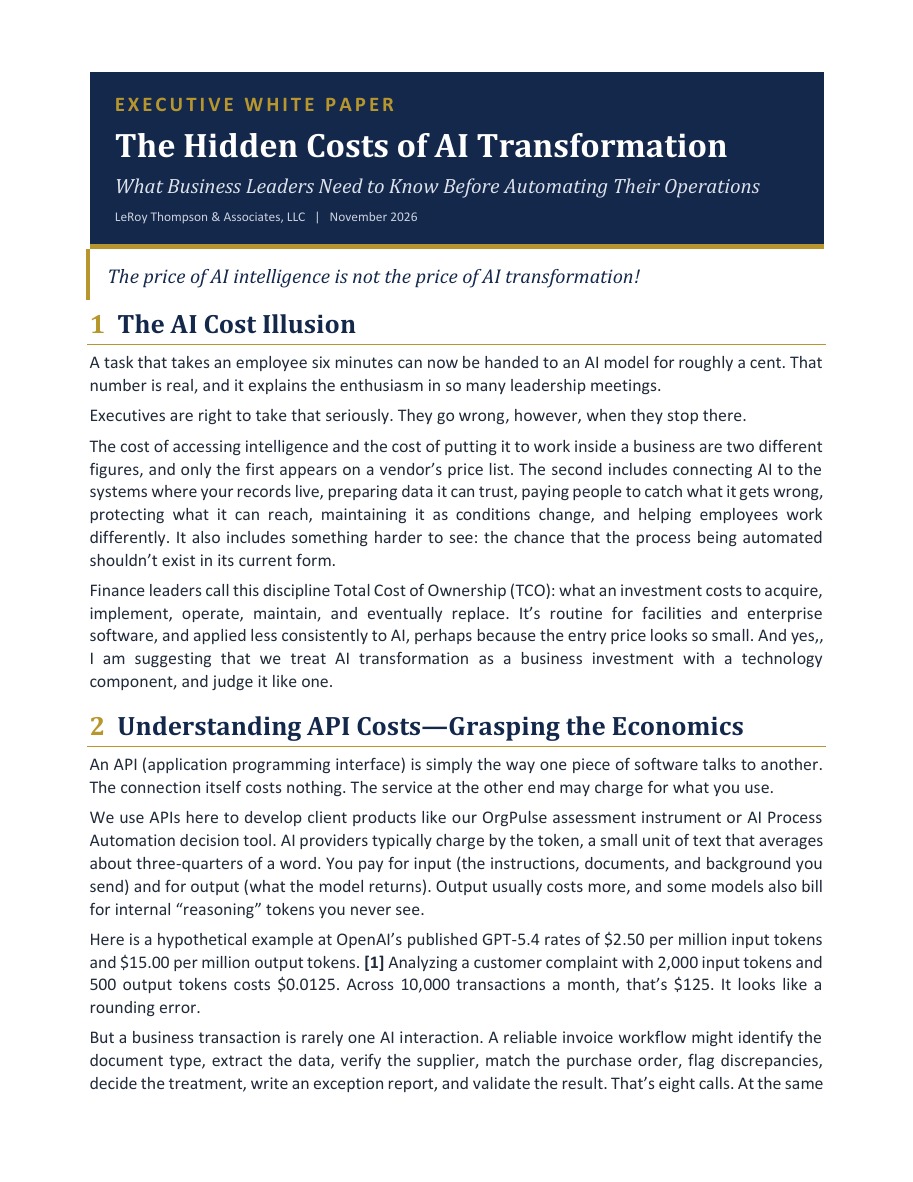
“The Hidden Costs of AI Transformation”
The software is only part of the price. See what else it takes to make AI work in your organization.
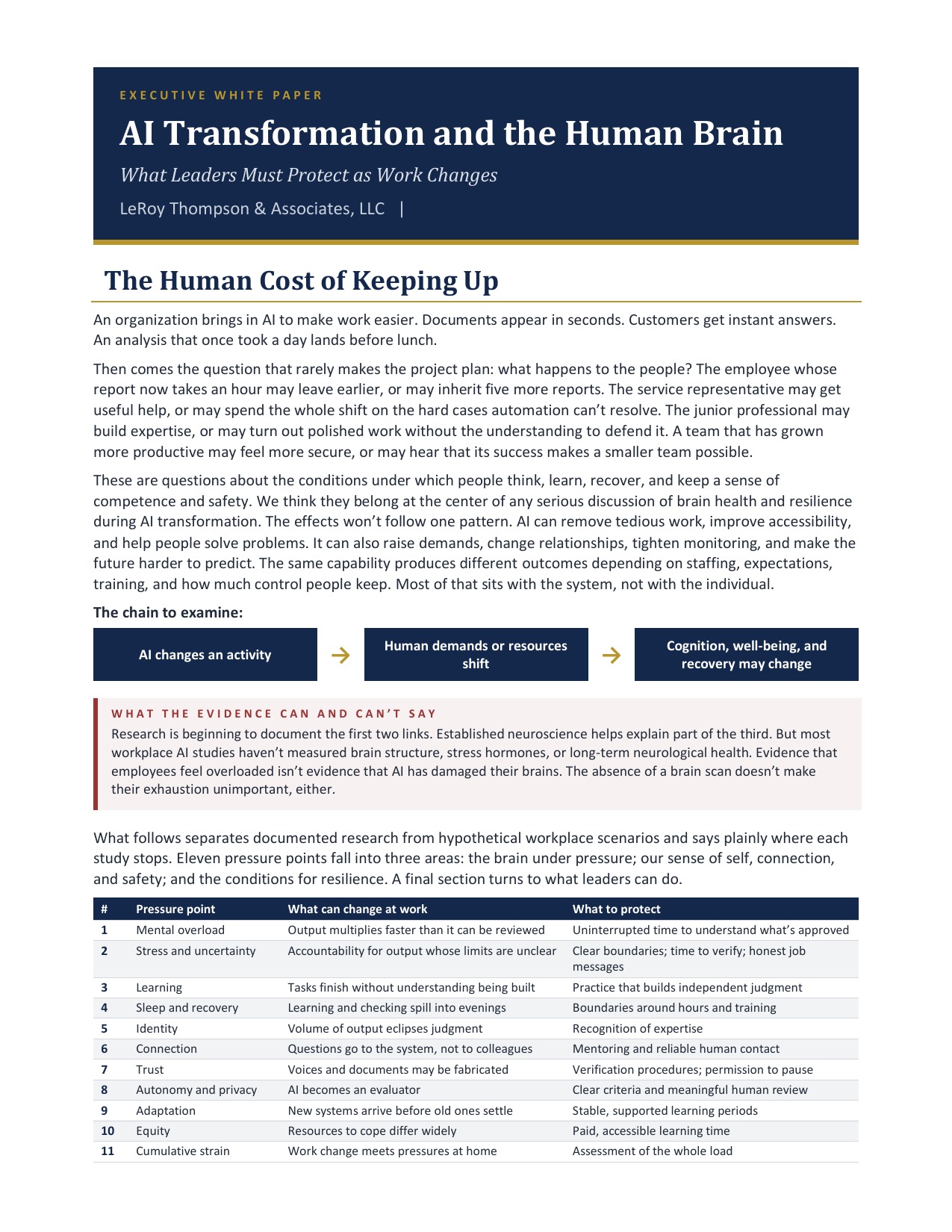
“AI Transformation and the Human Brain”
Change puts a real strain on the people doing the work. Learn what leaders must protect as work changes.
Digital Tools to Support Your AI Journey
We have also built four digital tools that put our approach in your hands.
OrgPulse
An organizational assessment tool that shows where your organization stands today.
AI Process Automation Assessment
A guide to choosing which processes to automate, and which to leave alone.
RFP Architect
Shreds even a complex RFP in less than five minutes, so you can get to your response faster.
AI Advantage
Helps you stay current on AI developments and evaluate the AI tools you already use.
Frequently Asked Questions
Why do so many AI initiatives stall after the pilot stage?
Because the pilot tested the technology, not the organization. A pilot usually works: a small group of motivated volunteers, plenty of leadership attention, and permission to do things differently. Then it’s time to scale. Now everyone else is being asked to change how they work, while the workflows, approvals, job expectations and performance measures around them are still built for the old way. That’s where it stalls. We look at what has to change around the tool, not just the tool itself.
Do we need an AI governance policy before our staff start using AI tools?
Yes, and your staff are probably already using AI tools whether there’s a policy or not. Without one, people guess. Some avoid AI entirely, and others put sensitive information where it doesn’t belong. A good first policy is short. It says which tools are approved, what information never goes into them, who reviews AI output before it affects a client or the public, and who to ask when you’re unsure. It can grow from there. The policy matters less than whether supervisors understand it and apply it consistently.
How do we get employees to adopt AI when many of them are anxious about their jobs?
Start by taking the anxiety seriously. It isn’t stubbornness. It’s a normal human response to a perceived threat, and the brain is wired to protect the status quo. Pushing harder usually deepens it. What helps is telling people plainly what will and won’t change in their jobs, involving them in deciding where AI can help, and letting them see early wins in their own work. People support what they help build. They resist what’s done to them.
What does an AI readiness assessment look like for a government agency or nonprofit?
It’s a look at whether your organization, not just your technology, is ready to absorb AI. We examine leadership alignment, how AI is already being used (formally and informally), policy and data practices, workforce skills and concerns, and which processes would benefit most. The work typically draws on interviews, a staff survey and document review. You come away with prioritized use cases, the governance gaps to close first, and a roadmap that names owners, sequence and how progress will be measured.
Is AI adoption a technology project or an organizational change project?
It’s both, but it almost always fails as a change project. The technology is increasingly easy to buy. Getting people to work differently, consistently, over time, is the hard part. An apparent technology problem is not necessarily a technology problem. When adoption lags, the cause is usually found in structure, incentives, unclear expectations or leadership consistency, not in the software.
What role do supervisors and middle managers play in making AI adoption stick?
They decide whether it sticks. Executives set direction and staff do the work, but supervisors make dozens of small decisions a day: what gets attention, what gets praised, and what “good work” looks like. If they don’t understand how AI fits into those decisions, or quietly doubt it, adoption fades no matter what the strategy says. Equipping supervisors is one of the highest-return investments in any AI initiative.
Contact me.
Interested in seeing one of these tools in action? Contact us to schedule a demo.